Wednesday, July 14, 2010

World War Two


War Horse

Michael Morphurgo


EDITED Please note that WarHorse was set in the second World War. The editor had a bit of a lapse and just threw it in the first world war at first.


We read this book on the train and in the car, we only got part way through before we got to London. We had tickets to the Theatre production of it. The book was from the horse's point of view but the production was from all the characters. It was like watching the actual story unfold. There was a great puppet goose on wheels for extra amusement. It also broke the tension. Max realised that it was not easy to define good from bad based on the side you were on. All characters can be good or bad. There are good Germans. All people and creatures are caught by the war. All suffer horribly. The cavalry were very outdated and not suitable for modern warfare. The horses were needed to pull the guns and ambulance wagons as the mud was terrible. We all felt the pathos of the war and the story of the boy and his horse.


The horse puppets were amazing and took three years to get together.


We had a tour of the Theatre the next day. Mum thought it was at the New National Theatre where the play had been , but it was at the actual theatre over the river. At least we got to go in a cab and learnt about "the knowledge". It takes the drivers three years minimum to learn the roads of London centre.


The boys were very good but we got to see behind the scenes and saw a version of the puppets. We were not allowed to take any pictures!


War Horse is a thrilling and spectacular production based on the celebrated ... Find out more on this official website, and book War Horse tickets direct ...
www.nationaltheatre.org.uk/warhorse


It seems like fun to try out the gear that a soldier had to carry and wear. But we found that it was heavy and that the whole business was fearful and horrific.

Also see some more photos from Duxford in that posting.

We listened to 'Adolphous Tips' by Micheal Morphurgo, we did and liked the story, it was about a coastal village in England that had to be moved out in order to practice for the Normandy Landings and a cat. Although it was more about the girl who was writing the story.

Henry read The Diary of Anne Frank and we visited the war cemetery in Holland (see the last section of the Netherlands)
World War II was a terrible event.

Anything for a good photo!

Churches

A standard bit of church art, this time from Pisa. Unsurprisingly the people from the Middle Ages had a realistic idea of death. Lots of churches had bones in their art and tombs.
St Peter's - so hard to photograph

St Paul's, London the copy

After the Great Fire in 1666, the old Cathedral of St Pauls had been totally destroyed. Sir Christopher Wren saw his chance to rebuild London and the Cathedral. He travelled on a grand tour of Europe to visit the cathedrals that he intended St Pauls to look like. He intended to make it beautiful and huge and with a large dome on top. All churches before this in England had been built with spires, not domes. Wren wanted to defy God's gravity to build a dome such as Santa Maria del Fiore in Florence that was built by Filippo Brunelleschi and St Peters, the Pope's church designed by Michelangelo Buonorotti (that famous guy -ed). He also visited the Medici Private Chapel in Florence, which we didn't get to see unfortunately, and studied the architecture there. It was also designed by Michelangelo. This chapel is all white and pure to look at, unlike the public churches which are all richly decorated. He also visited the ancient Roman building the Pantheon, which was built 1200 years before the Renaissance architects rediscovered the Roman secret of unsupported domes.


Florence
Florence

A vaulted ceiling with the decorated ceiling

I thought the Pantheon was huge, it is still the largest unreinforced concrete dome in the world (For pictures see ancient Roma post)

It holds Raphael's tomb. The feeling of standing under the 9m wide hole at the top is wondrous.

St Pauls was the first domed Cathedral in Europe that I visited. Mum got me to sing "Feed the Bird's" outside. St Pauls was extrelemy huge and richly decorated. We were not allowed to take photos in the inside. We climbed up the dome and saw London from very high up.

I found the dome of Florence's cathedral, Santa Maria del Fiore (Saint Mary of the flower) to be incredible and sublime. We had a really good tour guide for the cathedral.

St Peters was extremely beautiful and I wasn't used to it compared to what I was used to-our gothic cathedral in Christchurch. The whole thing was full of rich decoration, the ceiling on the vaulting, the statues the huge works of art. When you looked closely they were made of graded mosaics. The best thing was the Pieter. This is Michelangelo's statue of Mary and the dead Jesus. Ot was quite small compared to the other massive statues there, but it was very famous and valuable. (It had a polish and delicacy that all the others lacked-ed) It is the only work of Michelango that bears his signature.


By Henry


The medieval churches were amazing. We saw some earlier churches which are heavily built and quite dark as the windows must be small. They are hard to photograph.

The cathedrals of that time were built with buttresses. This allows the walls to be thin with the columns holding up stone arches up to 50m above the ground. Then tracery or stone patterns with glass between can fill up the spaces and let lots of light in. Henry sung in some and the sound is like a giant bathroom. We tried to imagine what it must be like with low wooden houses all around and then a huge church towering and being seen from miles around. -ed


Duomo on the florence skyline Duomo means House (dome) so it is a house of God

Henry does drawings like another artist Richard Macaulay, his book on Building a Cathedral we looked at a lot
Flayaran Abbey in France, one of the earliest abbeys still around. You can see where we got our cloisters from in the Art's Centre in Christchurch, all the monasteries had them for the monks and nuns to think in.


Tintern Abbey

Ruins in England

There were lots of ruins in England as Henry the VIII had decided to set up himself as the king of the church as well as of the country and the people. This was mostly because he wanted to divorce his wife and the Pope wouldn't let him. The Pope wanted all the power in England of the church. Henry didn't like this either. Henry the VIII decided to break with the Catholic Church and call himself the leader of the Church of England. He then dissolved the abbeys and got all the religious leaders to swear he was God's representative in England. Obviously this is a euphemism as there was huge destruction and lots of killings. There had been a move against the church for a while as Protestants in Germany, Holland and England thought that the Catholic Church was a bit too keen on images and golden things and not on being simple and godly. Tintern Abbey was one such monastery, only the skeleton remains and this was amazing. All religious art from England, as all art up until then was mostly religious was lost then too. -ed and Henry


A french Church, We visited all the little ones in the towns where we canal boated. This one had an photo opportunity! Henry practices his singing in them too. They always had lovely acoustics. It was like singing in a huge shower. Mostly these churches were very old and had Romanesque designs. This is quite solid and heavy, before the buttresses were invented for the gothic churches.

Flaran Abbey had a flash art gallery and some neat children's activiities. The boys made excellent portraits.
Here is a good use for a church square, the first town on the canal boat trip had a bit of a fair.
Valence sur la Baise church with its solid deisign and fair ground dodge-ems.
Notre Dame

Notre Dame in Paris was a gothic cathedral built before the Rennaisnace. It had massive flying buttresses to hold up the arched open walls inside. (Lots of famous people were buried there in flash tombs -George). Victor Hugo wrote a book called "The Hunchback of Notre Dame) to try to save the church which had nearly fallen down 100 or so years ago. Now there are queues to see it. There was a man dressed as a hunch back who snuck up and took mum's hand instead of mine and he gave mum a huge fright when she turned round and saw him instead of me. He was crouched very low so she didn't notice for a while. I felt weird! by George

Notre Dame

Bury St Edmonds

The Magna Carta was first discussed here. The first laws that stopped the king having absolute power. At first we thought that the huge abbey, had been wrecked by Henry VIII, like many others. But in fact the town’s people had grown tired of the excesses of the abbey, the leader or Abbot and the taxes that the monks wanted from the people. They drove the Abbot out and killed him and pulled some of the abbey down. However this wasn't the end of it as we thought, somehow it must have dissolved itself over time, perhaps the construction methods were a bit too crumbly. Now it is a pile of stones in the pattern of a great cathedral, with all the buildings round it. It is a park but some of the outer walls remain and one large gate was rebuilt not long after it was destroyed. -ed


Medieval life


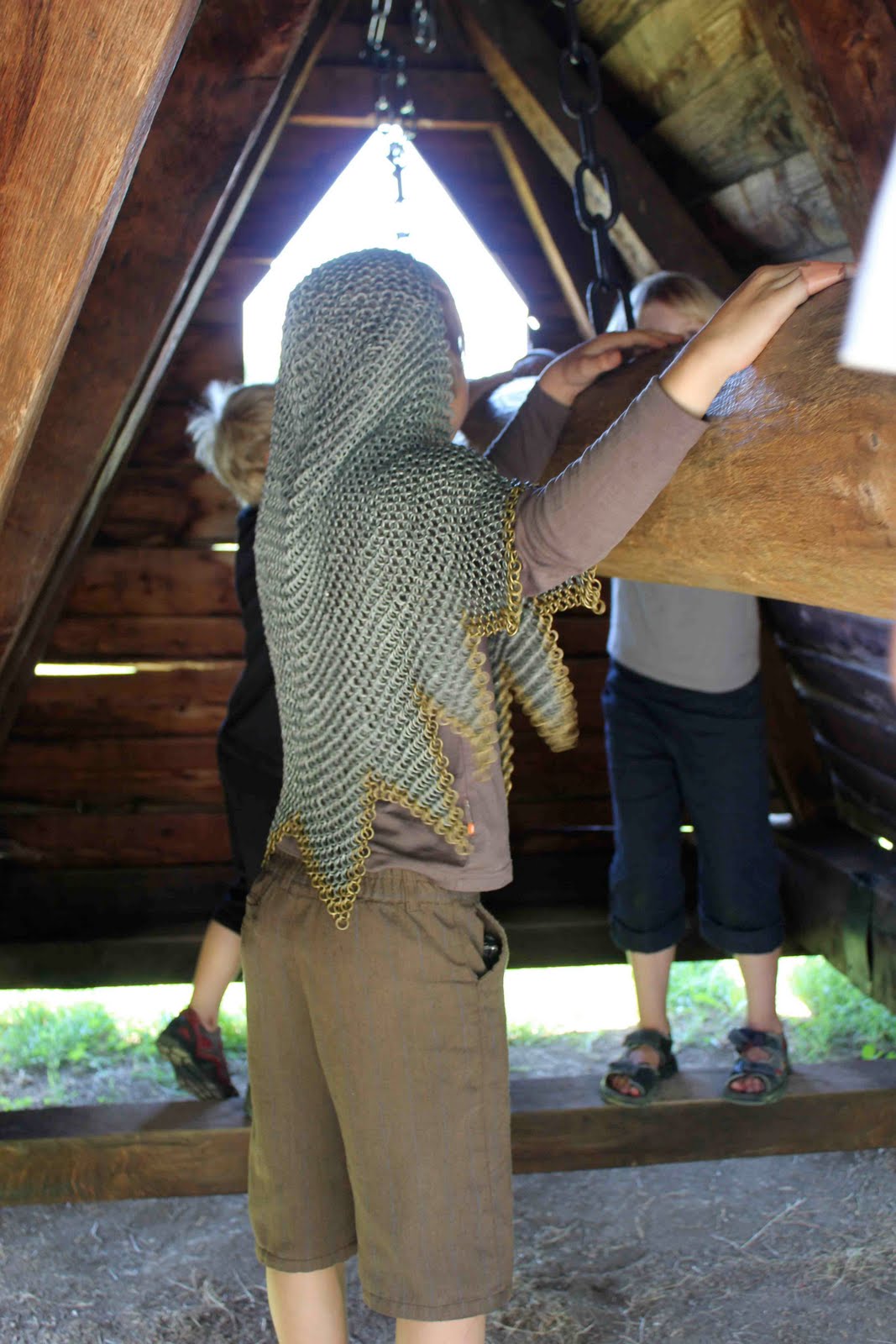
In France we visited a medieval siege camp in Larresingle, France. There was a castle there too.We got to wear some chain mail and choose a helmet. We couldn’t throw tomatoes or potatoes at each other in the stacks as they hadn’t made it to Europe yet. George thought that he wouldn’t wear chain mail again as it pulled the hairs out of his arms! But knights always had a fibre or leather suit underneath which also gave further protection. The helmets were made out of fibre glass which was much lighter, but still heavy on your head and hopeless to see out of! How on earth a knight could carry that much weight and wield weapons in a battle?


The castle we were pretending to attack had slits in the walls and platforms for archers and trebuchets and arrow throwing machines. They would throw boiling water, rocks and pooh and so on from the ramparts. (manure was funny in translation as the guide didn’t know that word and we didn’t know the French, we worked it out from an excellent miming routine however! – ed.) Larresingle had two keeps, a draw bridge a moat (not full anymore) and a portcullis. As attackers we had ladders, a 60cm horn which the dressed up presenter could blow very loudly.(We could all make it work a bit if we vibrated our lips as if you were playing a trumpet – ed.).They had a wheeled shield that about 8 men could hide under and push towards the walls without being killed. They had 5 siege engines and we were able to help fire three of them. We fired balls filled with water. We were able to lift the presenter up in the air with a trebuchet – it was fun! We also shot some arrows at a knight model. We dressed up too. There were all sorts of costumes. Monk, knight, peasant, but it was very hot to dress up. We made cannon balls for the trebuchets by chipping at rocks and we made some money out of lead with a pair of stamps (gold is too dear, but is also quite soft!) We saw a tool for twisting threads into rope.


The presenter showed us reproduction cannons too. There was a snake canon because the barrel is a long coiled piece of brass like a spiral. We didn’t get to fire these. The whole display and show was amazing. We were there all afternoon with just our family and the presenter to ourselves!
Larresingle shots, the ed. Can't get later pictures located further down the blog. It is enough to make you cross (bow) So I have to move the text around instead.


The tower also contained the Royal Mint, where the coins were made. It had to be secure.


The Tower Of London and Fit for a king

The tower was a royal Palace during medieval times, it was built as a defensive castle during the Norman Conquest. However they built their castle on top of Roman remains as the site was a good one beside the river. It was always meant to be a fortress and a stronghold. But it has also been a royal residence and could be used for defence. It is still protected by Beefeaters or Yoemen. To be in the Yoemanry you have to have special skills and been high ranking in the army. There is one New Zealand yeoman. The tower is one of the oldest buildings in London and it still houses the Crown Jewels. The Jewels are heavily guarded with red coat soldiers, cannon, videos, safes and big, very thick doors. They had massive opals, diamonds and other precious stones in the crowns and sceptres or sticks of state. Shimmering huge gold bowls and all manner of treasure. We were not allowed to take pictures. The Black Prince Ruby is not a

ruby but a rhutile (evidently, according to Henry –ed.) The Elizabeth Diamond is 5cm across. (Henry was carried away by the Jewel shops where you can buy miniature or copies of bits and pieces, we bought a glittery knight for the Christmas tree!)

There are many walls and towers, there are several gates, one leads to the river and is called “Watergate”. Prisoners came in this way from the Thames River. The moat is now drained. It became very stinky as it was stagnant. There are still some medieval living quarters there with very old furnishings.

We saw siege engines being operated here and the presenters were dressed up in medieval gear. The clothes were interesting. There was a professional soldier, a peasant soldier and his wife who joined the fight and a lady whose husband was killed by the nasty Scots!

We loved the armory were set up on a plastic frame like an airfix kit. Then a video of animated building of the airfix kit. You couldn’t see any hands building but the armour was pushed out and all the parts taken out and painted and put together on a model man. It was exciting and crafty to see. Some of the real pieces on display were held in place by giant plastic airfix sections. Other bits of armour were put together as if on a horse or a man. “ I would like a set of armour!”

Knights


We found out that you had to be rich to be a knight. You had to buy your own armour, horse and weapons. The armour would have cost more than a poor person’s house. Most soldiers were poor serfs or peasants who went to battle on foot. Often they wouldn’t have much to fight with. Sometimes they weren’t trained, but just had to do what they were told and then get home afterwards to plant the fields or do the harvesting. Barons kept better trained men, they had a pole weapon, a sword and a small shield some protective clothes with plates on their hands, elbows and shoulders with strips or splints of metal between them to stop their arms being cut by swords. Disciplined foot soldiers and archers became more common later on in the middle ages and this was the end of the big, heavy knights. One archer could take down a knight form a distance. Sometimes barons were almost more powerful than the King as he didn’t have an army but relied on the help of the Barons. He had to keep them happy and they had to serve the King.

We also visited castles in England. There was Chepstowe Castle, it was great. We bought a wooden model of a siege engine to build at home. We also visited one in Abergavenny in Wales, where we bought some daggers made of wood. We have had lots of battles.


Images the first ones above, except for the one of our presenter at Larresingle being pulled up by us on a siege engine. -Ed

Each village was owned by a lord and his lady. They made all the rues and decisions for the village. The next person down was the steward who worked for the lord, he was better off than the peasants. Then there was the bailiff who ran the estate day to day. Then there was the Reeve who was elected by the peasants. He made sure that nothing was stolen. The peasants did not own their land or house and paid rent in the form of crops and so on. The lord owned the mill, the grape press and so the villages had to use these and give part of their harvest to the Lord.

Trousers were a pair of hose or legs that were tied on at the to the doublet, this is why we have a pair of trousers!


Internet is hard!

At last we have a computer again. Hotels are a bit hopeless as you have to quickly have a go in the foyer or time is too short. We have stayed in very few hotels anyway. Our week stays have all had internet issues. I can't use my phone as a modem yet and canal boats, apartments in the Dolomites and houses here and there don't have access. We have lots of bits ready to go so I will see what I can do, but the photos are taking me an age to get on.....
Ed.


Friday, July 2, 2010

The Netherlands By Henry


Windmills or Moulins in Holland

Made of wood and maybe with a thatched roof. They were massive with elaborate wooden gears. Pegs, perfectly timed with the cogs to rotate. Gears and cranks turning a smaller shaft coming from the blades to the cog called a brake wheel to the wallower or cogs so that the shaft goes from the top to the very bottom to grind up flour or anything you want with the humongous stone wheels (at least 5000kg each)


The blades at the top were made entirely out of wood with a canvas sail covering to catch the wind. The mill keeper would take the canvas sails off at night and tie down the blades to make it safe. The millers lived in their mills and worked very hard. Since Holland or the

Netherlands is near the sea and is quite flat there would usually be wind. (The mills were built 300- 400 years ago and were used for a mini-industrial age before the invention of steam engines. Holland had a large trade and manufacturing base and the area around Amsterdam was very wealthy due to this. The water ways and connection to the sea allowed all sorts of materials to be moved in and out efficiently. - ed.)

We saw two big mills in the Zaans Museum and village. One was used to grind pigments, for example chalk for white, cinnabar for red, lapis lazuli for blue/green and copper minerals for greens and a dark wood for

brown. Also colours of Earth from Italy like burnt Sienna. They came from al over the world. Paint was made with the pigments and oil. We saw glass sheets and glass rubbers to

mix it together. (Leonardo da Vinci liked to experiment with pigments and make his own paint, some of it didn’t last too well though –ed)

There was also an oil mill. It was violently loud and made a deafening din. Bang,

bang, bang, bang! People did used to become deaf, it was called pounding deafness. I found the noise very unbearable. A huge block of wood hitting a wedge of wood that then

presses all the previously ground nuts in a bag. To squash the meal and gradually get the oil out, the banging must go on for ages.

The museum was good and there were plenty of tourist shops. One of which was burgled, and diamonds stolen by three armed men. Someone was hurt ad pushed through a window. The police had “do not cross

tapes” when we were looking round as the burglary had just happened.

We stayed in Broek in Waterland near Amsterdam during our stay. It is a small village close to Amsterdam. The houses were very old, many from 1700 and built in an old style. Or house was from 1770. It

had logs for beams in the ceiling. They had collected all sorts of olden day stuff. The walls were painted with scenes of the countryside and a ceiling with birds and clouds. We slept in sleeping cupboards. We walked through the village and visited the church which was also very old and had graves under all the floor stones with writing and carving on them. (The church was burnt down in the late 1700’s as the Spanish conquered and

ruled the Dutch. They tried to stamp out Protestantism. For this reason the women still sit on chairs in the inner part and the men sit on the edges on pews. This is from when the church goers had services on the grass and feared being attacked when their church was burned. Astained glass window shows this part of

their history. –ed)


By Suzanne….

We wanted to visit Flora, my mother’s cousin when we were there. Her father had been decorated after the war for his efforts in the Resistance. He has a tree planted for him

in Israel. We hoped to talk to Marte, my grand father’s sister about the war. She is almost 90. She is the last one from that generation alive now from our family. I had seen her 23 years ago and she looked very similar really. I noticed, again all the mannerisms shared by Albert, my grandfather! She did talk to us a lot. But it was all in Dutch and a bit circular. I can only understand the simplest things, but we taped her so that my mother might be able to translate and we would have a recording of her voice. We know that she was imprisoned for a while as the Germans wanted to find her sister and brother in law who were in safe houses at the time. The boys have been reading fiction and non-fiction books about the wars and trying to find out more about it all in Britain and Europe. We haven’t looked at the German perspective however, as I haven’t found much suitable for children. I think that Max especially realised that there is no clear division between right and wrong and good and bad from Watching War Horse in London.

We visited Osterbeck, the cemetery for the 1700 troops who lost their lives in the parachute drop of troops to try to capture the bridge over the Rhine in Arnhem. “Operation Market Garden.” The troops were not able to be supported by divisions from the south as expected and what should have been a three day operation became a nine day house to house battle that they had to be withdrawn from. We found some New Zealand graves and many unknown graves. There were many, many stones. The boys were confused at first by the Polish insignia as they thought the eagle was German. Flora said that there were no Germans buried there. This was not the only cemetery for troops and airmen from the Second World War in Arnhem

. It is hard to imagine the waste of human life and all the sadness that flowed on from those deaths.

Flora gave Henry Anne Franks Diary to read. Anne Frank was a 13 year old Jewish girl who went into hiding in Amsterdam with her family to escape the holocaust by the Nazis. Her family were betrayed and their hiding place discovered. Anne and her sister were killed in Concentration Camps. Her father published her diary so that she could “live on” as she had said she wanted to in her dairy. Can you imagine being rounded up and killed? It was all very sobering.

On a brighter note, we met Flora in the old first class lounge in Amsterdam's railway station. There was a cockatoo there. He was funny. We thought he was called Afbluven but that means "Do not touch" He was called Elvis!